The Marketing Funnel
Awareness, consideration, conversion and sales — what each stage is for, the metric that belongs to it, and why the funnel is a planning tool rather than a description of how people actually buy.
On this page
Every media plan you will ever read is organised by the funnel. Every budget argument is a funnel argument. Every "this campaign underperformed" conversation is usually someone judging an upper-funnel tactic by a lower-funnel metric.
It is also, as a description of how human beings buy things, wrong — and knowing exactly how it is wrong is what separates someone who uses the funnel from someone the funnel uses.
The shape
A large number of people could buy your product. A small number do. Draw that as a cross-section and you get a funnel.
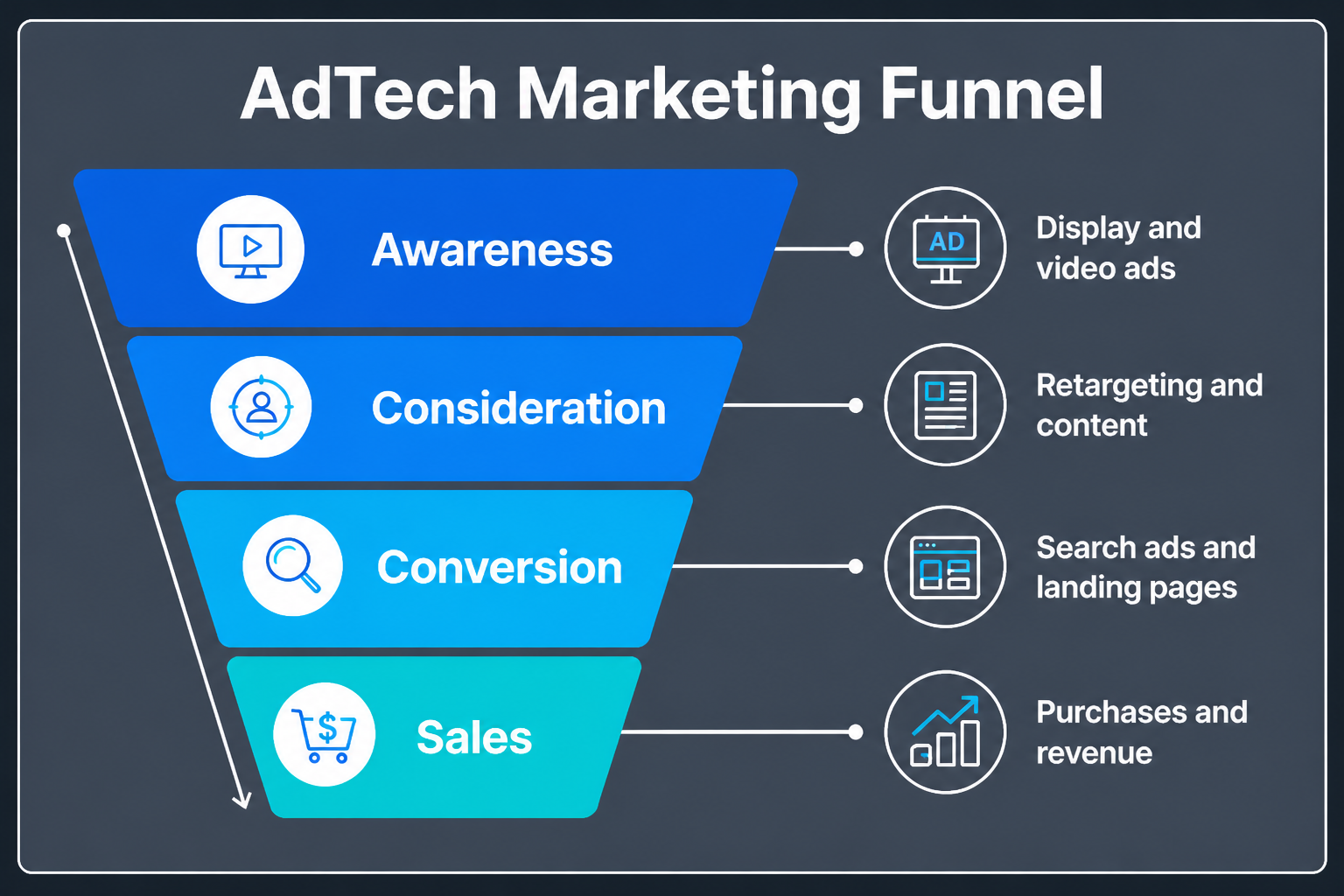
The numbers attached to those stages are what make the shape matter. A plausible set for a mid-sized consumer brand: 10,000,000 people reached, 400,000 who engaged, 25,000 who reached a product page, 2,000 who bought. Each step down is roughly an order of magnitude, and each is paid for separately.
Four stages is the common modern cut, and the stage names are a house style rather than a standard. You will meet three (upper, mid, lower), five with loyalty or advocacy bolted on the bottom, and the original AIDA — Attention, Interest, Desire, Action — which Elias St. Elmo Lewis sketched out in 1898. The idea underneath has not changed in 125 years.
What each stage is for
The stages differ in who you are talking to, which changes what the advertising has to do.
| Stage | The person | The job | Typical channels |
|---|---|---|---|
| Awareness | Does not know you exist | Be memorable, reach broadly | CTV, online video, audio, DOOH, display |
| Consideration | Knows you, comparing options | Be the obvious answer | Social, video, content, retargeting, influencer |
| Conversion | Actively shopping | Be present at the moment, remove friction | Search, retail media, product pages, retargeting |
| Sales | Has bought | Keep them | Email, loyalty programmes, subscriptions, remarketing |
Note that the same channel appears at different stages depending on how it is used. A display banner can be a broad reach buy or a retargeting hit. Funnel position is a property of the targeting and the creative, not of the format.
Awareness
Being known. The goal is that when someone is eventually in the market, your brand is one of the few they can already name — what the Ehrenberg-Bass people call mental availability.
Two consequences follow. First, it is bought on reach, not on response: you are paying to enter a memory, not to prompt an action this week. Second, it mostly happens away from your own properties — most product research starts somewhere other than a brand's own website, so your site being good is irrelevant to whether anyone arrives.
Consideration
Being shortlisted. The audience here knows you exist and is comparing you with three or four alternatives, so the job shifts from memorability to differentiation: answer the question, address the objection, show the proof.
This is where reviews, comparisons, demonstrations and case studies do the work, and where retargeting first starts to make sense — the person has signalled interest, so you are no longer guessing. It is also the stage with the weakest measurement, which is why it is the first to get cut and the one whose absence is felt six months later.
Conversion
Being bought. The person has decided what they want; the job is to be in front of them at that moment and then get out of the way.
Also called the decision or purchase stage. Tactics are the ones with observable intent attached — search, retail media, product pages — and the stage is easy to measure precisely because a click often sits immediately before the purchase. That ease is a trap, covered below: the click you can see is usually not the thing that caused the sale.
Sales
The sale is the start of the relationship, not the end of it. Acquiring a new customer runs several times the cost of retaining an existing one, so for most businesses the money is in the second purchase and the fifth.
A funnel drawn only down to the first transaction will quietly encourage you to buy the same first purchase over and over. Email, subscriptions, loyalty programmes and remarketing belong here, and they are an advertising decision as much as a CRM one.
The metric that belongs at each stage
This is the part that matters, and the part most commonly got wrong.
| Stage | Judge it by | Do not judge it by |
|---|---|---|
| Awareness | Unique reach, frequency, video completion rate, brand lift | ROAS, CPA |
| Consideration | Product page views, branded search volume, new-to-brand share | Last-click revenue |
| Conversion | ROAS, CPA, conversion rate, units sold | Reach |
| Sales | Repeat purchase rate, subscription rate, customer lifetime value | Anything measured in a single campaign window |
In practice people group these as TOFU, MOFU and BOFU — top, middle and bottom of funnel — and compare each group against its own benchmark rather than against each other. A TOFU campaign and a BOFU campaign put side by side on the same ROAS column is not an analysis; it is a category error.
Why the funnel is wrong
Three well-founded criticisms. Hold all of them at once.
People do not move in one direction
A real purchase looks like a loop: see an ad, forget it, see a friend's post, search, read a review, get distracted, see a retargeting ad, compare prices, abandon a cart, come back three weeks later. People re-enter at the top after being near the bottom. Google's "messy middle" research describes this as looping between exploration and evaluation rather than descending a chute.
It treats a buyer as a stage, not a person
The funnel describes a population moving through stages. It is frequently misread as describing an individual, which leads to nonsense like "this user is in consideration" — a claim about someone's mental state inferred from the fact that they loaded a page.
Shoppers enter anywhere
Someone can arrive at a product page from a friend's recommendation having never seen a single ad, buy on the spot, and skip two stages outright. The funnel is a map of the paths that exist, not of the path any given person took.
Why it survives anyway
Because it is a good planning tool even though it is a poor behavioural model. It gives you three things nothing has replaced:
A budget split you can argue about. The Binet and Field work — analysing the IPA databank — put the long-run split at roughly 60% brand, 40% activation for the average B2C business. You can disagree with the number, but the funnel is what lets you have the conversation at all.
A way to catch a gap. If every line on your plan is retargeting and search, you have no awareness spend, and you are harvesting demand somebody else created. That is efficient until it is not.
A shared vocabulary. When a planner says "we need more upper funnel", everybody in the room knows roughly what will be bought and what it will be judged by.
How this maps onto adtech
The funnel is why the machinery is shaped the way it is.
- Upper funnel buys reach, so it is priced on and bought where attention is concentrated — CTV, video, audio.
- Lower funnel buys intent, so it is priced on clicks or actions and bought where intent is observable — search, , retargeting.
- Identity matters more at the bottom. You cannot retarget someone you cannot recognise, which is why the privacy decade hit lower-funnel tactics hardest and pushed budget back toward contextual and upper funnel.
- is a funnel argument in disguise. Last-click gives all credit to the bottom. Every alternative model is an attempt to pay the top something.
Check yourself
A CTV awareness campaign reports a 0.4:1 ROAS in the last-click dashboard. What is the most defensible response?
Key takeaways
- Four stages — awareness, consideration, conversion, sales — describing a population narrowing from everyone who could buy to the few who do, and then whether they come back.
- Each stage has its own metric. Judging an awareness campaign on ROAS is the most expensive routine mistake in media.
- Funnel position is a property of targeting and creative, not of the format. The same banner can be upper or lower funnel.
- As behaviour it is wrong: real buying loops, re-enters, and can skip stages entirely. As a planning tool it survives because nothing replaced the budget conversation it enables.
- Brand search and retargeting always look best in a last-click report and are usually the least incremental. Test, do not assume.
Next
The Intermediate band picks up where the plan meets the machinery: How an RTB Auction Works is what actually happens when a line on that plan becomes an impression.